Treesa Jolly and Gayatri Gopichand tease history with their heroics in the World Championship

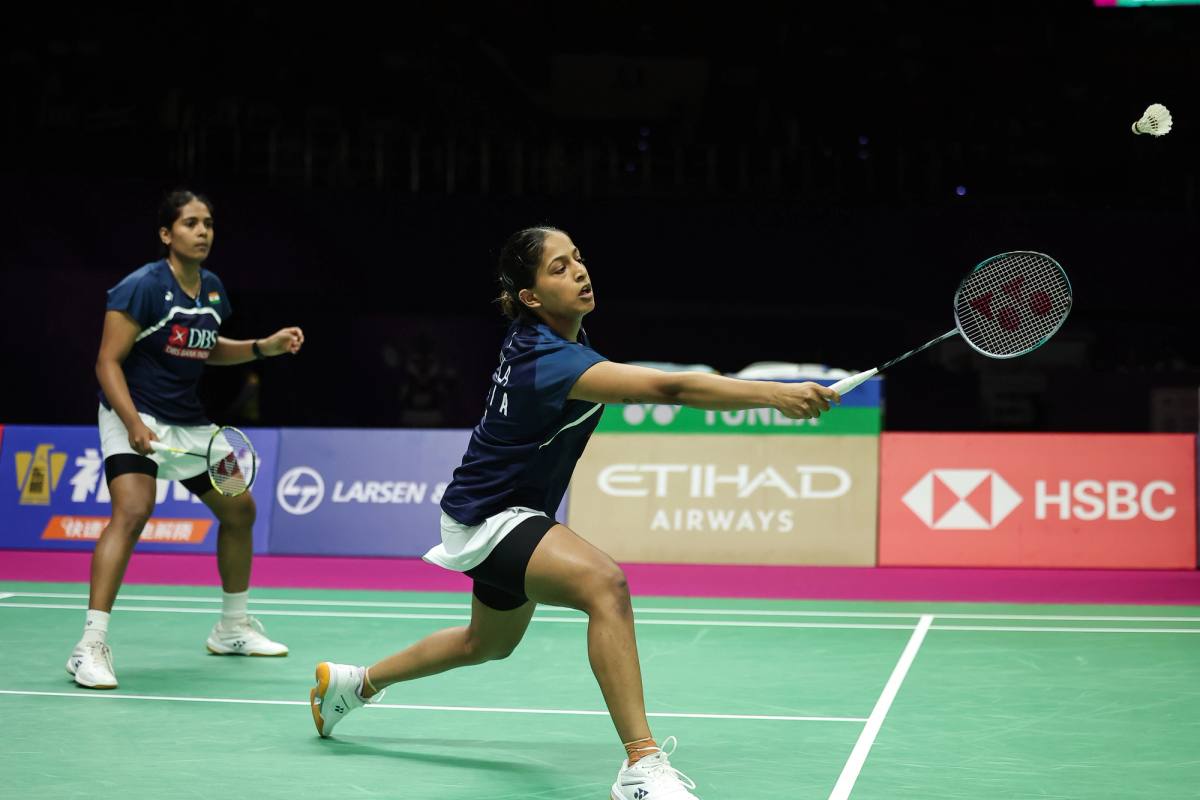
Treesa Jolly and Gayatri Gopichand - BAI Images
NEW DELHI: There is a particular sound Indian badminton has waited fifteen years to hear again inside the Indira Gandhi Indoor Stadium: the roar that follows a women's doubles pair beating China. On Friday evening, Treesa Jolly and Gayatri Gopichand produced it, coming back from a game down to stun fourth seeds Jia Yi Fan and Zhang Shu Xian 16-21, 21-15, 21-13 in the quarterfinals of the BWF World Championships. The heroic quarterfinal performance guaranteed India a medal in the discipline for only the second time in the tournament's history.
The first time belonged to Jwala Gutta and Ashwini Ponnappa, whose bronze in London 15 years ago opened a streak that India has now maintained at every World Championship since 2011. Reflecting on Friday's win with HardYards, Ponnappa herself did not hide her admiration. "Incredible win. I think they've been playing really well this entire tournament, and they've also been playing very confidently, and that showed with the way that they executed their strokes on court today. So, remarkable performance," she said.
Asked how a pair returning from injury layoffs could summon such form, Ponnappa pointed to a lightness that only freedom from expectation can produce. "Sometimes that just eases the pressure off them. Not having expectations helps a lot, because you can play your game more freely. And when you play freely, you play what you're really good at," she said, describing Treesa and Gayatri as "a great all-round pair. They can attack, they can defend, they can counter-attack, which really helps, because women's doubles is about sustaining long rallies, finding the right moments to go in for the win."
The match did not begin like history in the making. Treesa and Gayatri fell behind 0-6, then 2-8, their swings a fraction late against a pair carrying an Olympic and World gold pedigree between them. They clawed back to 8-9 with a run of six straight points, only to watch the Chinese pair regather and shut the door on the opening game.
Then something shifted.
Ponnappa, watching closely, saw a partnership built on interchangeability rather than fixed roles. "Treesa definitely has a massive smash, but it doesn't necessarily mean that she has to be the one hitting. Although when she does that, Gayatri is super sharp at the net. But Gayatri also holds her own from the back of the court, because she's very good and clever with her placement and the pace of the smashes that she hits. And of course, Treesa is super sharp at the net too. So they can play either role," she explained.
That fluidity showed in the second game, as the pair worked from the mid-court together, absorbing drop points but grinding through prolonged rallies rather than rushing the net. They won eight straight points to seize control at 9-4 and did not look back, closing out the game and the decider by widening margins that Chinese pairs are rarely made to absorb.
Speaking to reporters courtside soon after, Gayatri kept circling back to one word: patience. "I think just be calm and patient and just be in the present moment, that's actually what we need to do to score points against them. Those kind of mindset was there. I think that really worked," she said, describing a directive from their coach that had become almost a mantra. "They always said like just calm down and just be in the present moment. I think that really worked today. I think that's the kind of advice we keep behind us."
She was candid, too, about the moments she had not managed to control. Recalling a painful loss earlier this year, she admitted, "I have messed up with so much of greediness to get the scoring the points... I still remember when we played the India Open, it was such a great match we played, but if I could have been a little bit calmer and patient, we could have just scored points and won that match."
Behind that hard-won composure lies a partnership built through injury as much as through triumph. Three days before the Asian Championships and the Uber Cup, Treesa suffered an ankle injury in training that kept her off the court for weeks, missing tournaments she had trained years for. She described the toll plainly: "It's been sad and emotional, kind of missing those major tournaments representing India. I think Gopi sir, my parents, my friends, everyone was there behind me who supported me to just recover as soon as possible and be fit. At that time, she was also training;
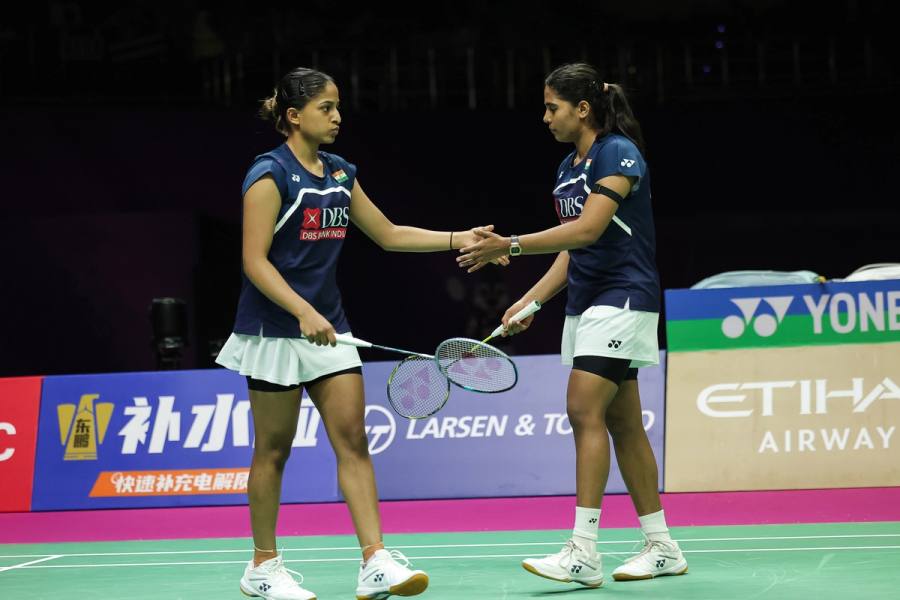
she was also waiting for me. I was telling her I will come soon."
On beating a fourth-seeded pair for the first time in three meetings, both were measured rather than euphoric. "Right now we're just processing this. We're into the semifinals and on the podium, but it's not finished yet, because this is not the end. We came here with a goal," Gayatri said, before adding a detail that reframed the achievement: this was, in fact, their third World Championships as a pair, their first medal arriving on home soil.
"I think the crowd was so amazing, and even when we lost the first game, they were in full josh, saying come on, come on girls, you can do this. I think that really helped us," she said.
Waiting in Saturday's semifinal are top seeds Liu Sheng Shu and Tan Ning, the most dominant pairing in the women's game. Treesa and Gayatri were deliberately unfazed when asked about them. "We don't want to think too much. We don't want to think about the outcome too much. We just want to get on court first, and I think we're playing well, and we just want to keep doing that and see what happens," Gayatri said.
No Indian women's doubles pair has ever reached a World Championships final. Whatever colour their medal ultimately becomes, Treesa and Gayatri have already rewritten what was thought possible for Indian doubles on a home stage, one rally, one rehabilitated ankle, and one shared season of belief at a time.

Keep Reading
The Capacity for Suffering
On the baseline, greatness is written in sweat and split seconds: endure the long rally, find the line under pressure, adapt at match point, and take the next…
US Open: No Sinner, No Certainty in an Open Draw
Jannik Sinner is out, Alexander Zverev is top seed and Carlos Alcaraz returns after four months. Inside the 2026 US Open draw at Flushing Meadows.
US Open: The Crucible at Flushing Meadows
Discover how tennis stars battle grueling injuries and physical strain at the US Open, competing under the electric lights of Flushing Meadows in Queens, NY.