Satwik-Chirag succumb to Chinese pace

Satwik - Chirag - BAI Image
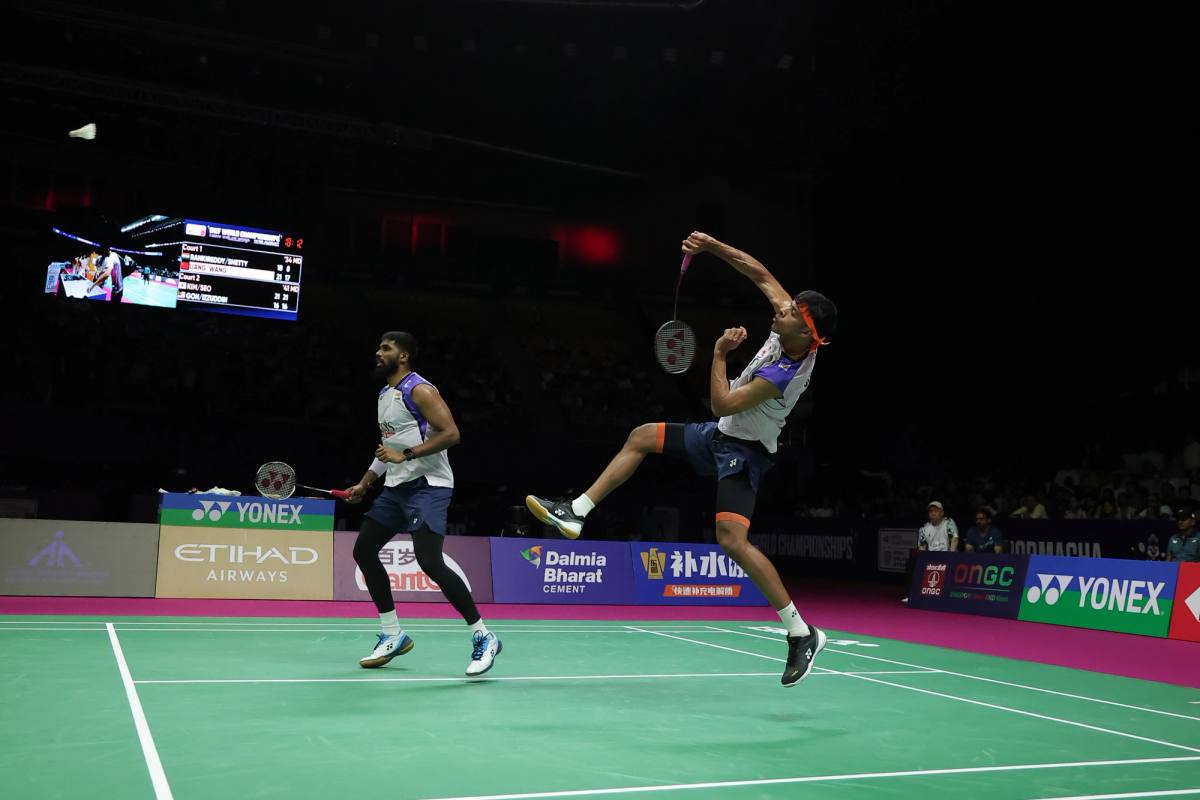
Satwiksairaj Rankireddy and Chirag Shetty reached the World Championships quarterfinal with evidence that they could still deliver under pressure. But China’s Liang Wei Keng and Wang Chang gave them no margin for a slow passage, winning 21-18, 21-9 in a defeat that exposed the demands of elite men’s doubles on a pair rebuilding fitness and match sharpness. The loss ended the Indians’ pursuit of a third World Championships medal and extended their head-to-head deficit against Liang and Wang to 4-10.
The first game carried the tension expected of a contest between fifth seeds and third seeds, and the score stayed level at 4-4, 8-8, 10-10 and, later, 18-18. Satwik and Chirag matched Liang and Wang through the opening exchanges, with the crowd in the Indira Gandhi Indoor Stadium supplying the noise. But at 18-18, errors did what neither pair had managed through sustained attack: they separated the teams. Chirag made two costly mistakes, one into the net and one wide, and China claimed the last three points of the game.
That finish changed the contest. Liang and Wang play a flat, fast game that denies opponents the time to set their attack, and they doubled down on it in the second game. India failed to disrupt the Chinese pair’s rhythm with enough lifts, clears or changes of pace. The shuttle remained low, the exchanges stayed rapid, and the opportunities for Satwik’s full jump smash were scarce. Chirag carried much of the attacking load, but Liang and Wang’s defense absorbed it and sent the pressure back across the net.
This was not simply a matter of a close first game slipping away. In men’s doubles, the difference between a competitive scoreline and a one-sided finish often lies in whether a pair can reclaim the serve and control the first three shots. India could not. Liang and Wang pushed ahead early in the second, kept the shuttle flat and made the Indians defend from uncomfortable positions. The 21-9 scoreline reflected the collapse of a tactical contest into a race that India could no longer run.
The 36-minute duration mattered. A day earlier, Rankireddy and Shetty had needed more than 80 minutes to beat Malaysia’s Junaidi Arif and Yap Roy King in three games, following a draw that had already given them a first-round bye and second-round walkover. Satwik said he felt “pretty much okay” after six weeks of rehabilitation and strengthening for his shoulder, but he acknowledged the short recovery window after the previous match.
That caveat should not become an excuse. Liang and Wang were sharper in the moments that decided the match, and their control of tempo offered a straightforward explanation for the outcome. Still, the Indian pair’s physical condition framed the evening. Satwik’s shoulder problem had forced first-round retirements in Indonesia and Japan, soon after their Singapore Open title in late May ended a two-year title drought. The World Championships were meant to test not just their ranking but their readiness to absorb tournament pressure again.
They had reason to believe they could overcome this opponent. Rankireddy and Shetty defeated Liang and Wang at the same World Championships stage last year, while their Thomas Cup meeting this season went to the wire. This quarterfinal never approached that edge. China’s Olympic silver medallists took the first game when it tightened, then removed all uncertainty from the second.
The home crowd had already watched Treesa Jolly and Gayatri Gopichand produce the day’s Indian breakthrough, recovering from a game down to defeat Jia Yi Fan and Zhang Shu Xian 16-21, 21-15, 21-13. Their victory assured India of a medal and extended the country’s run of winning at least one medal at every World Championships since 2011. It also made them only the second Indian women’s doubles pair to secure a Worlds medal, after Jwala Gutta and Ashwini Ponnappa in 2011.
For Rankireddy and Shetty, the contrast was stark. Treesa and Gayatri found a way to turn defence into attack after a slow start. Satwik and Chirag were drawn into the game their opponents preferred, then could not get out of it.
In the singles draws, the men's category is guaranteed a new world champion after second seed Kunlavut Vitidsarn of Thailand—the only former champion left in the field—was knocked out by Frenchman Alex Lanier. Vitidsarn took the opening game but lost momentum, falling 19-21, 21-16, 21-16. Lanier will next face Canada's Victor Lai, who ended the run of Denmark's Rasmus Gemke with a 21-19, 21-18 victory, while Japan's Kodai Naraoka defeated Anders Antonsen 21-19, 21-15 to complete the semifinals lineup.In women's singles, former world champion Nozomi Okuhara withdrew due to a knee injury, handing Thailand's Pornpawee Chochuwong a walkover.Top seeds An Se Young (21-19, 21-12 over Han Yue), Akane Yamaguchi (21-17, 21-10 over Michelle Li), and Wang Zhi Yi (21-10, 21-7 over Line Christophersen) all secured straight-game victories to advance.

Keep Reading
The Capacity for Suffering
On the baseline, greatness is written in sweat and split seconds: endure the long rally, find the line under pressure, adapt at match point, and take the next…
US Open: No Sinner, No Certainty in an Open Draw
Jannik Sinner is out, Alexander Zverev is top seed and Carlos Alcaraz returns after four months. Inside the 2026 US Open draw at Flushing Meadows.
US Open: The Crucible at Flushing Meadows
Discover how tennis stars battle grueling injuries and physical strain at the US Open, competing under the electric lights of Flushing Meadows in Queens, NY.