One Big Leap: Lokesh Sathyanathan fires up Indian athletics with an NCAA Crown

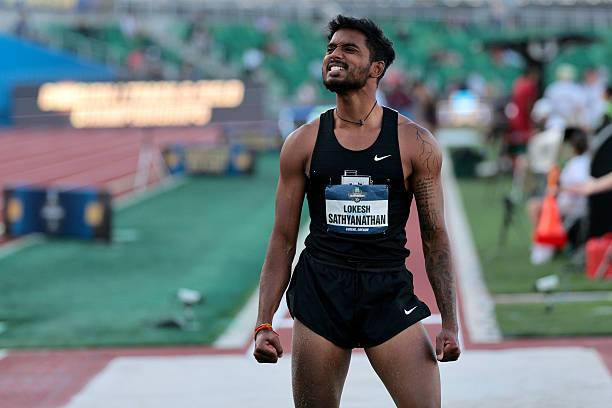
On a cold March evening in Fayetteville, the Randal Tyson Indoor Center went briefly silent as Lokesh Sathyanathan settled at the top of the runway. Twenty‑six years old, wearing Tarleton State purple, he rocked once on his heels, then sprinted into an eight‑second blur that ended 8.21 metres away in the sand—an NCAA Division I indoor title, a new Indian indoor national record, and a moment that launched the Karnataka native into a global story of athletics. Lokesh emulates an elite group of Indians - Mohinder Singh Gill (triple jump), Vikas Gowda (discus throw) and Tejaswin Shankar (high jump) - the only other Indians to win an NCAA Division 1 Athletics Championships.
Dusty lanes of Bengaluru
To understand that jump, you have to rewind to the dense, improvised athletics world of Bengaluru’s school system. At Al‑Ameen College and its associated clubs, Lokesh emerged the way many Indian athletes do: through early‑morning heats on worn tracks, where medals can mean fee waivers, hostel places, or simply a reason for a family to keep saying yes to sport. Coaches noticed he wasn’t the tallest or the loudest, but he was unusually composed between the take‑off board and the landing pit, with the two gifts that matter in long jump: runway speed and control in the last three strides.
By his late teens he was more than a promising local talent. Lokesh stacked up three Indian U20 long jump titles in 2019, eight national gold medals in age‑group competitions, and three junior meet records, enough to earn a reputation as one of the sharpest young jumpers in the country. But he earned his stripes on the collegiate circuit in the USA. The past three years have seen a wave good jumps by Indian athletes. Murali Sreeshankar secured Gold in Greece with a remarkable 8.31 in May 2022. A year later, Jeswin Aldrin launched himself to that national record, 8.42m at Bellary. Young David and VK Elakkiyadan also leapt past the 8m mark inside the Anna Stadium in Chennai in May. Just weeks earlier, Lokesh won the Mountain West Outdoor Track and Field Championships in Clovis, California jumping 8.02m.
Indian long jump has transformed in the past decade. Once peripheral to the nation’s track mythology, it now boasts Aldrin’s 8.42 m national record and Sreeshankar’s 8.41 m as proofs that Indian athletes can live at world‑class distance. Lokesh grew up under the shadow of those numbers—distances circulated on social media as screenshots and memes, the eight‑metre mark turning from an abstract barrier into a reachable standard. For a boy from Bengaluru’s school meets, the message was clear: somebody from here had already done it outdoors. The question became not whether an Indian could fly that far, but whether he could.
What makes Lokesh’s story distinct is where he chose to chase that question. Instead of anchoring himself in India’s national camps, he took a route increasingly common among Indian track-and-field hopefuls: crossing into the U.S. college system. At the University of New Mexico, he collected a Mountain West outdoor gold medal in long jump, a conference meet record, and USTFCCCA second‑team All‑America honours in 2023, pushing his outdoor best to 8.02 m in Clovis, California. That mark quietly placed him alongside the country’s best, even if most Indian fans still didn’t know his nickname—“Loki”—or the fact that he was jumping half a world away.
The indoor revolution
Indoors, everything tightens: the runway shrinks, the crowd presses closer, there is no wind to blame or bless a performance. For Lokesh, the 2025–26 indoor season became a laboratory where small adjustments turned into historic outcomes. In January, he opened with 7.80 m in Texas, followed by a 7.83 m win in Oklahoma, steady steps toward a form he felt was coming but hadn’t yet fully shown. Then, at the Tyson Invitational in Fayetteville in February 2026, he broke through: 7.69 m, a foul, 7.94, 7.99—and finally 8.01 m, the first time an Indian had ever crossed eight metres indoors, eclipsing Jeswin Aldrin’s 7.97 m national indoor record from 2023.
That 8.01 m only placed him eighth in a loaded field that included world champion Tajay Gayle and Olympic silver medallist Luvo Manyonga, yet it mattered enormously back home. In a country without its own indoor circuit, here was an Indian jumper rewriting the national record books under a foreign roof, in a meet most Indian fans would encounter through a three‑minute highlight reel on their phones. It made clear that the geography of Indian athletics success had shifted: national milestones were now being set in American college arenas.
Title night in Fayetteville
By the time Lokesh arrived back at the Randal Tyson Center for the NCAA Indoor Championships in March, the venue already held his best and his future. Tarleton State, his new home after a transfer from Louisville, had never produced a Division I national champion in any sport, making him both the programme’s spearhead and its experiment. The stakes were layered: win a title for Tarleton, deepen his national record for India, and prove that his Tyson Invitational breakthrough was not a one‑off.
The final unfolded slowly. Early jumps placed him among the leaders but not ahead of them. Then, in the fourth round, the pieces aligned: the controlled acceleration, the board hit perfectly, the hang in the air just long enough for 8.21 m to flash up on the scoreboard. He followed it with 8.17 m on his last attempt, a second confirmation that this was a new level, not a lucky gust of form. The numbers told their own story: NCAA champion, Tarleton’s first Division I national title, and a revised Indian indoor record that now belongs entirely to him—8.01 m, then 8.21 m, with 8.17 m as further evidence in between.
Carrying more than a flag
Off the runway, Lokesh’s biography adds texture to the result. Born in 1999 to John Sathyanathan and Felcy Mary in Bengaluru, he has spoken about the difficulty of returning to athletics after his mother’s death, naming that bereavement as the hardest challenge he has faced. His proudest moments, he says, have been wearing India’s colours at national and international meets; his long‑term dream is as much entrepreneurial as athletic—building his own clothing line once college is done. The NCAA title, then, is a waypoint rather than an endpoint: proof that a path exists from Indian school circuits to global podiums, and a platform from which to imagine a life that does not neatly fit the old script of government jobs for medal‑winning athletes.
In the wider tapestry of Indian athletics, Lokesh now hangs alongside triple jumper Mohinder Singh Gill and high jumper Tejaswin Shankar—Indian athletes who became NCAA champions while doubling as ambassadors of a sporting nation still catching up with its talent. His 8.21 m places him just behind Aldrin and Sreeshankar on India’s overall all‑time lists, but in one respect he stands alone: the first Indian to own an NCAA Division I indoor title in long jump, and the author of a new chapter of Indian performance written on an American runway.
Back in Bengaluru, the school tracks that shaped him remain messy, the lanes still slightly uneven. Somewhere in that mix, another teenager is measuring out their run‑up, watching YouTube clips of an 8.21 m jump in Arkansas. For them, Lokesh’s leap is no longer a distant miracle. It is a line in the sand that says: this far, and maybe a little farther.
Photo by C. Morgan Engel/NCAA Photos via Getty Images

Keep Reading

The Capacity for Suffering
On the baseline, greatness is written in sweat and split seconds: endure the long rally, find the line under pressure, adapt at match point, and take the next…
US Open: No Sinner, No Certainty in an Open Draw
Jannik Sinner is out, Alexander Zverev is top seed and Carlos Alcaraz returns after four months. Inside the 2026 US Open draw at Flushing Meadows.

US Open: The Crucible at Flushing Meadows
Discover how tennis stars battle grueling injuries and physical strain at the US Open, competing under the electric lights of Flushing Meadows in Queens, NY.