Carlos Alcaraz forces the hand of history; Elena Rybakina earns sweet revenge

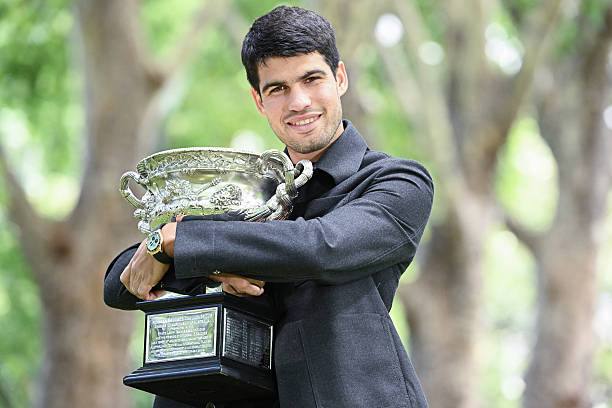
In Melbourne this year, the trophies went to Elena Rybakina and Carlos Alcaraz, but the Australian Open felt less like a changing of the guard than the sharpening of an emerging hierarchy. Rybakina finally claimed the hard-court major her game has long foreshadowed, while Alcaraz completed the career Grand Slam by beating Novak Djokovic on the very court that had most symbolized his predecessor's dominance.
Rybakina's Quiet Revolution
Rybakina's 6-4, 4-6, 6-4 victory over Aryna Sabalenka was officially framed as revenge for their 2023 final, but the deeper story concerns how a supposedly streaky, fragile contender has evolved into one of the most structurally reliable big-match players on tour. Down 0-3 in the deciding set—with the world number one having seized five straight games and seemingly reasserted the established order—Rybakina changed nothing dramatic. She simply tightened the margins, found first serves, and trusted that Sabalenka's aggression would eventually overshoot.
What distinguished this comeback was its texture. Sabalenka's run from 4-4 in the second set to 3-0 in the third looked utterly familiar: backhand winners, booming returns, the soundtrack of full-throated roars. Rybakina answered not with theatrics but precision—six aces overall, six of eight break points saved, and back-to-back returns that forced errors at 3-1 and 3-3 to flip the set on its axis. For a player often caricatured as emotionally distant, the key proved her composure under maximum volatility, her capacity to keep hitting her spots while Sabalenka's unforced errors mounted at the finish line.
Rybakina's second major—following Wimbledon 2022—arrives after two years of intermittent illness, scheduling disruptions, and persistent questions about whether she could stay healthy long enough to cash in on her talent. She had lost their 2023 final and watched Sabalenka construct an aura in Melbourne with consecutive titles in 2023 and 2024. Now she has beaten the same opponent in back-to-back hard-court finals and won seven of their last nine meetings on the surface. In a women's field often reduced to narratives of volatility, Rybakina's Australian Open triumph feels like a corrective—an argument that quiet, methodical shotmakers can construct dynasties too.
The implications ripple beyond one match. Sabalenka remains world number one and a hard-court force, but Rybakina now owns victories over her at Wimbledon, the WTA Finals, and in a Melbourne final. She has demonstrated she can out-serve and out-steady the Belarusian in the very moments Sabalenka used to dominate. For the locker room, the message lands bluntly: the Sabalenka problem now has a template, and Rybakina authored it with depth, serve accuracy, and emotional discipline rather than sheer power.
Alcaraz and the Weight of History
On the men's side, the narrative carried more volume, because history usually does. Alcaraz's four-set victory over Djokovic—2-6, 6-2, 6-3, 7-5—made him the youngest man to complete the career Grand Slam and only the ninth in history to achieve it, joining Djokovic, Nadal, and Federer in a club that once defined an entire era. It was also a circular moment: the player who had already beaten Djokovic in a Wimbledon final now did it in Melbourne, in the stadium Djokovic has dominated like no one else.
The match itself felt like two finals compressed into one. For a set and a half, Djokovic played at a level reminiscent of his peak, timing the ball so cleanly that Alcaraz looked rushed and under-equipped. The pivot arrived on a net-cord backhand in the second set that died on Djokovic's side—an almost absurd piece of fortune that handed Alcaraz his first break and, just as importantly, license to believe this final could be chaotic rather than scripted. From that point, he recalibrated: returning closer in, taking greater risk with the forehand up the line, and using his movement to transform Djokovic's flat drives into defensive shots.
In career terms, this fortnight in Melbourne completes a map that already looked improbably dense for a twenty-two-year-old. Alcaraz had first won the US Open, then Wimbledon and Roland Garros, and now adds the Australian Open to complete the set, having won each Slam in his first final appearance there—something only Serena Williams had achieved in the Open Era. He accomplished this in a draw that required surviving an epic semifinal against Alexander Zverev before beating Djokovic, who arrived fresh from another five-set war with Jannik Sinner. The pattern is unmistakable: when tournaments become survival exercises, Alcaraz finds the edge in the biggest matches.
Yet the deeper significance lies in what this does to the tour's psychic landscape. Djokovic's runner-up speech—half-joke, half-confession that he was uncertain whether he would return to this stage—hinted at a fundamental shift. The Australian Open can no longer be treated as his private domain. Alcaraz, with majors now on all three surfaces and victories over Djokovic in two Slam finals, is no longer the heir apparent. He is the co-author of the present.
The New Hierarchy
Rybakina and Alcaraz's titles paint a narrative that is simultaneously more open and more stratified than the "post-Big Three" cliché suggests. On both tours, the players with the cleanest, most transferable games are consolidating their positions at the top, but they achieve it in different registers: Alcaraz with noise and improvisation, Rybakina with understatement and control.
Melbourne 2026 didn't merely crown two champions. It clarified who, for now, is setting the terms of what it means to be great.
Carlos Alcaraz - Photo by James D. Morgan/Getty Images

Keep Reading
The Capacity for Suffering
On the baseline, greatness is written in sweat and split seconds: endure the long rally, find the line under pressure, adapt at match point, and take the next…
US Open: No Sinner, No Certainty in an Open Draw
Jannik Sinner is out, Alexander Zverev is top seed and Carlos Alcaraz returns after four months. Inside the 2026 US Open draw at Flushing Meadows.
US Open: The Crucible at Flushing Meadows
Discover how tennis stars battle grueling injuries and physical strain at the US Open, competing under the electric lights of Flushing Meadows in Queens, NY.