The Collapse Complex: Perth Exposes Modern Cricket's Technical Deficit

The grim shadows in Perth wore a foreboding look of incapacity, as batting woes continue to beseech Test cricket around the world. As the Ashes lay scattered across Perth's turf, its traumatised blades of grass echoed the pathos of Eden Gardens. The men in white flannels continue to stain the game with their glaring ineptitude as long form cricket remains embroiled in a cloud of persistent pain. The carnage in Perth, where 19 wickets tumbled on the opening day of the Ashes series, revealed far more than just a lively pitch or brilliant bowling. The dismissals on Friday exposed a growing crisis in modern batting—an inability to adapt technique and temperament to the demanding conditions that define Test cricket's enduring challenge.
England lasted just 197 balls while cobbling together 172 runs. The Ashes hadn't seen a shorter first innings since Australia were bundled out in 193 balls in 1902. Australia fared scarcely better, collapsing to 123 for 9 by stumps. This wasn't merely entertaining theatre; it was a symptom of something more troubling—batters across both teams struggling with fundamentals when confronted with pace, bounce, and lateral movement.
Mitchell Starc's career-best 7-58 didn't just showcase his mastery with the new ball; it ruthlessly exposed technical deficiencies that have become endemic in the modern game. The nature of the dismissals tells the story.
Zak Crawley lasted six balls before edging to slip—a classic failure of footwork. The delivery wasn't exceptional; it was on a hard length angled across him. But Crawley, without proper foot movement, drove on the up and paid the price. This pattern of batting without feet, relying on hand-eye coordination rather than technique, has become disturbingly common.
Ben Duckett's dismissal for 21 exemplified another modern failing. After punishing Scott Boland's half-volleys, he was trapped lbw by Starc with a full-length ball. Duckett played across the line—a cardinal sin in seaming conditions—and the review confirmed his fate. The aggressive intent was there, but the technical foundation to execute it safely was absent.
Joe Root's seven-ball duck was perhaps most telling. The world's number-one ranked Test batter, still searching for his first Ashes century in Australia, was squared up completely by a delivery that pitched on leg and seamed away sharply. Starc had set him up with a wide line before firing one at his eyeline at 142.8 kph. Root, jabbing with a closed bat face, could only nick to third slip. For a batsman of Root's caliber to look so tentative against quality pace bowling raises uncomfortable questions about preparation and adaptability.
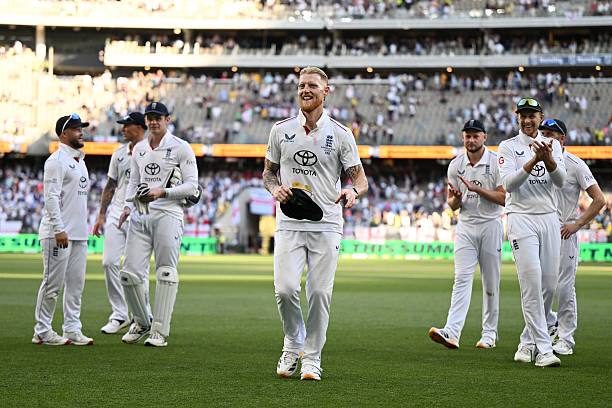
Ben Stokes' dismissal crystallized England's batting fragility. The captain was clean bowled by a scrambled-seam delivery that pitched outside off and swung back viciously through the bat-pad gap. Stokes, looking to drive on the up, missed completely and ended sprawled on the ground in disbelief. It was a "jaffa," as commentators noted, but also a shot selection born of impatience rather than match awareness.
England's aggressive "Bazball" philosophy, designed to revolutionize Test cricket, backfired spectacularly when confronted with Perth's pace and bounce. The last five wickets collapsed for just 12 runs in 19 balls—a capitulation that suggested panic rather than intent.
Harry Brook's dismissal illustrated the double-edged nature of modern aggressive batting. After a scintillating 52 off 61 balls—the only English half-century—he gloved a short ball from debutant Brendan Doggett down the leg side. Brook had been criticised previously for his struggles against short-pitched bowling, and here again, the technical limitation was ruthlessly exploited. Jamie Smith's 33 off 22 balls provided brief entertainment before he holed out to deep mid-wicket attempting another aggressive shot off Starc.
Former England spinner Phil Tufnell called Australia's bowling "a one-man show," but the reality was England's batting was a collective abdication of responsibility. Only four batsmen reached double figures. The aggressive approach that had worked on flatter pitches became suicidal when conditions demanded defensive solidity.
Australia's batting offered little comfort, suggesting this isn't merely an English problem but a generational shift in how batsmen approach Test cricket. Their collapse to 31 for 4, and eventual 123 for 9, displayed similar technical frailties.
Steve Smith, the stand-in captain, survived 49 balls for 17 runs, playing nearly 50 percent false shots before edging Brydon Carse to second slip. The delivery surprised him with extra bounce, catching the shoulder of the bat. For a batsman of Smith's pedigree to look so uncomfortable was striking—he'd been hit on the elbow and fingers before his dismissal, never settling into his usually idiosyncratic rhythm.
Usman Khawaja's dismissal was particularly brutal. Brydon Carse produced a "snorter"—a delivery that kicked viciously off the pitch, catching Khawaja completely off-guard as he snapped his head back and gloved it to the keeper. He lasted just six balls for two runs. The delivery was unplayable, but Khawaja's initial discomfort suggested he hadn't adequately prepared for the pace and bounce.
Travis Head (21) and Cameron Green (24) attempted counter-attacks but both fell to Ben Stokes, unable to convert starts into substantial innings. Head, caught at short mid-wicket, and Green, edging behind after being drawn wider, exemplified batsmen scrambling to survive rather than committing to build an innings.
The struggles in Perth cannot be divorced from broader trends in modern cricket. Indian coach Gautam Gambhir has noted that defensive techniques have been compromised by T20 cricket's influence. "Sometimes you're so used to muscling the ball that you end up forgetting the soft hands," Gambhir observed.
The statistics support this assessment. Since 2018, batting averages in Test cricket have declined sharply, with bowlers increasingly dominant. England have been dismissed for under 100 four times since 2018—more than any other Test side. India's recent home losses to New Zealand and struggles in Australia have exposed similar technical deficiencies.
The issue isn't merely aggression; it's the erosion of defensive technique and the abandoning of temperament. Young cricketers developing skills around power-hitting in T20 leagues lack the patient, defensive mastery their predecessors honed. And the experienced batters are burning their manuals in their quest to adapt their game to the shorter format.
The ball itself has changed. The enhanced seam on modern Kookaburra balls means deliveries move more dramatically. Combined with pitches deliberately prepared to assist bowlers—partly driven by World Test Championship incentives—batsmen face conditions unlike any previous era.
India's struggles at 46 all out against New Zealand, Sri Lanka's 42 all out against South Africa, and Australia's 104 against India in Perth last year all preceded this Ashes opener. The pattern is clear: when conditions favor bowlers, modern batsmen lack the technique and temperament to cope.
Steve Smith's balls-per-dismissal rate when defending—193.1, significantly ahead of his contemporaries—shows defensive solidity remains crucial. Yet increasingly, batsmen are abandoning this foundation in favor of aggressive strokeplay that works on flat pitches but crumbles when the ball moves.
Friday's carnage in Perth was cricket at its most brutal and revealing. Both Starc and Stokes produced exceptional bowling—Starc's 7-58 marked the best individual figures at Perth Stadium—but their brilliance was magnified by batsmen ill-equipped to counter quality pace bowling in helpful conditions.
As the series progresses, the team that addresses these technical deficiencies—footwork against pace, defensive solidity under pressure, shot selection appropriate to conditions—will prevail. Day one in Perth didn't just showcase great bowling; it exposed a generation of batsmen struggling with Test cricket's fundamental demands. The Ashes has always been cricket's greatest examination. On Friday, most students failed.
Ben Stokes - Photo by Gareth Copley/Getty Images

Keep Reading

The Capacity for Suffering
On the baseline, greatness is written in sweat and split seconds: endure the long rally, find the line under pressure, adapt at match point, and take the next…

US Open: No Sinner, No Certainty in an Open Draw
Jannik Sinner is out, Alexander Zverev is top seed and Carlos Alcaraz returns after four months. Inside the 2026 US Open draw at Flushing Meadows.

US Open: The Crucible at Flushing Meadows
Discover how tennis stars battle grueling injuries and physical strain at the US Open, competing under the electric lights of Flushing Meadows in Queens, NY.