Elena Rybakina turns the tables on Aryna Sabalenka

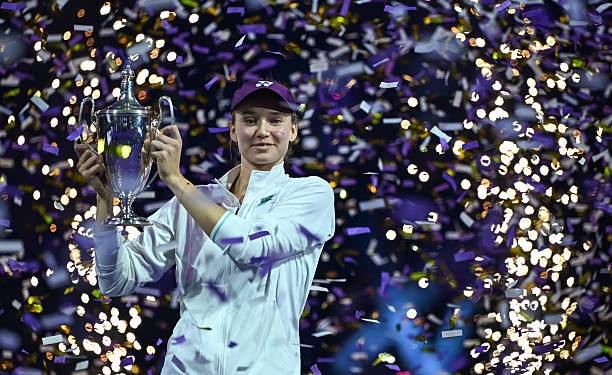
Elena Rybakina's coronation in Riyadh drew a sharp line under women's tennis in 2025—a sport caught between tradition and transformation, between packed stadia and half-empty arenas, between record paydays and uneasy questions about where the game should be played. The Kazakh with the ice-cold baseline game dismantled world No. 1 Aryna Sabalenka 6-3, 7-6(0) on Saturday night, pocketing $5.235 million—the richest single payout in women's sports history—and finishing an undefeated 5-0 run through the WTA Finals.
Here's what nobody saw coming: the last player to qualify became the last one standing. Rybakina entered Riyadh as the No. 6 seed, squeezed into the field in the tournament's final week, her ranking having dipped into double digits earlier this year amid coaching chaos and inexplicable early exits. Two weeks later, she's hoisting the Billie Jean King Trophy and extending her winning streak to 11 matches straight.
Rybakina's performance against Sabalenka wasn't just impressive—it was surgical. She struck 13 aces, outwinnered Sabalenka 36 to 12, and saved all five break points she faced. The second-set tiebreak? A 7-0 demolition that left the world's best player visibly stunned. For someone who'd won a record 22 tiebreaks this season, Sabalenka had never lost one 7-0 in her career until Saturday night.
The statistics tell a ruthless story. Rybakina won 82 of 146 total points, dominated at net (10 of 12 successful approaches), and broke serve just once—the only break of the entire match. That lone break came at 2-2 in the first set when she tracked down a Sabalenka volley, lobbed brilliantly, and watched the world No. 1 net an overhead.
"I was trying to stay very focused," Rybakina said afterward. "Even in the tiebreak, only when I heard 'game, set, match' did I realize the match was finished, because I'd been up in tiebreaks before and lost them".
This victory caps a season that tested Rybakina in ways Grand Slam finals never have. In February, the WTA suspended her longtime coach Stefano Vukov for a year after an investigation found he'd engaged in "abuse of authority and abusive behavior," including undermining her psychological and emotional well-being. Vukov appealed and returned to her corner in August, though he was barred from player areas and denied credentials throughout much of the season.
The turnaround was swift. Rybakina won titles in Strasbourg and Ningbo earlier this season, but Riyadh represents her biggest triumph since Wimbledon 2022. She finished 2025 with three titles from five finals, a 58-19 match record, and a return to the top five in the rankings.
Riyadh hosting the WTA Finals for a second straight year embodies women's tennis in 2025: spectacular on-court action, complicated off-court realities. The three-year deal with Saudi Arabia has brought unprecedented prize money ($15.5 million total this year) and financial stability after the tournament bounced between six venues in six years. Last year's WTA Finals in Riyadh attracted 78 million viewers globally, a 160% increase over the previous year—largely due to China's return to broadcasting WTA events.
But the compromises are stark. The King Saud University Indoor Arena seats just 4,200 people, half the capacity of the venue where men played the Six Kings Slam exhibition a month earlier, and far smaller than the 133,000 fans who attended the 2017 WTA Finals in Singapore. Early-round matches saw just 400 spectators in the stands, prompting criticism from legends like Tim Henman and Martina Navratilova.
By the final, however, the arena was buzzing. "It's much better this year," Sabalenka noted. "The crowd was there from the very first match, and the support was amazing. I'm super happy to see how tennis is growing here".
Women's tennis in 2025 defies easy summaries. The WTA's global audience hit 1.1 billion in 2024, up 10% year-over-year, with on-site attendance rising 15% to 3.5 million across all tournaments. Prize money is soaring—Sabalenka earned $12,313,519, the closest any player has come to matching Serena William's record haul of $12,385,572 in 2013.
Yet the sport's hierarchy remains fluid. Rybakina's win makes her the 10th consecutive first-time WTA Finals champion and the first player representing Kazakhstan—or any Asian nation—to claim the title. She's also just the second player since Tracy Austin (1979-80) to defeat the world No. 1 in back-to-back WTA Finals appearances.
Her head-to-head record against Sabalenka now stands at 5-8, with three of those wins coming in finals—Indian Wells 2023, Brisbane 2024, and Riyadh 2025. The rivalry has become one of the tour's most compelling narratives, defined by heavy groundstrokes, towering serves, and razor-thin margins.
Here's what the critics miss: women's tennis struggled with attendance in Cancun and Texas before Saudi Arabia ever entered the picture. The real issue isn't geography—it's the WTA's decades-long failure to build consistent branding around its season-ending championship. Moving the event every two years makes it nearly impossible to cultivate local fanbases or establish tradition.
Riyadh's investment, controversial as it may be, has given the WTA something it desperately needed: financial certainty and global reach. Whether that's worth the tradeoffs is a question players, fans, and officials will continue debating long after the confetti settles.
Rybakina will enter 2026 as a legitimate title contender at every major tournament. Her composure under pressure—saving five break points in a $5 million final—suggests she's finally learned to manage the mental game that eluded her earlier this season. After the trophy presentation, she notably refused to pose for photos alongside WTA CEO Portia Archer, underscoring lingering tensions over the Vukov suspension.
Sabalenka, meanwhile, finishes 2025 as year-end No. 1 for the second consecutive year, joining an exclusive group of just seven women to hold the top spot across consecutive calendar years. Her 59-11 match record, four titles (including the US Open), and 15 top-10 victories defined the season's benchmark.
The Australian Open in January promises a rematch. Can Sabalenka reclaim her throne? Or has Rybakina's resurgence shifted the balance of power?
Elena Rybakina - Photo by STR/NurPhoto via Getty Images

Keep Reading
The Capacity for Suffering
On the baseline, greatness is written in sweat and split seconds: endure the long rally, find the line under pressure, adapt at match point, and take the next…
US Open: No Sinner, No Certainty in an Open Draw
Jannik Sinner is out, Alexander Zverev is top seed and Carlos Alcaraz returns after four months. Inside the 2026 US Open draw at Flushing Meadows.
US Open: The Crucible at Flushing Meadows
Discover how tennis stars battle grueling injuries and physical strain at the US Open, competing under the electric lights of Flushing Meadows in Queens, NY.