Drawing Inspiration from Drawn Victories

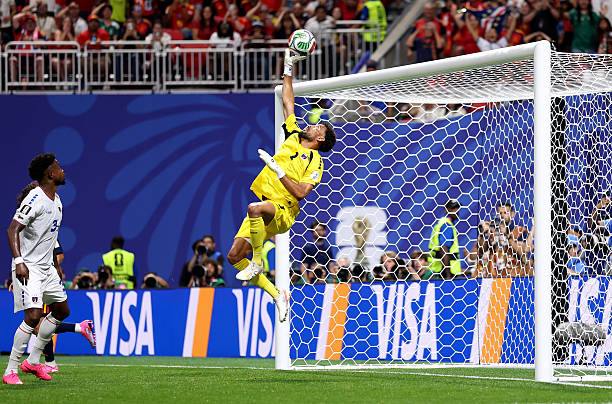
By the time the final whistle sounded in Atlanta, the best goalkeeper on the field was a 40-year-old who had begun the week with about 50,000 followers online and would end it with eight million. His name is Vozinha. He keeps goal for Cape Verde, a country of barely half a million people, with ten islands scattered across the Atlantic off the West African coast. He had just made seven saves against Spain: Ferran Torres, Pedri, Aymeric Laporte, and, when the favourites finally sent on the teenager Lamine Yamal to break the deadlock, him too. The scoresheet stayed at 0–0. Then Vozinha bent over his own goal line and wept, and his teammates buried him.
The scoreboard called it a draw. The scoreboard was lying.
Here is what the standings table never tells you about a draw. One point each, it says. Fair and square. Nothing to see. But a draw is a beam of light, and where you stand decides what it is. From the Spain bench, that 0–0 was a smudge - 27 shots, nearly three-quarters of the ball, a back line worth more than the entire Cape Verdean league, and nothing to show for any of it. From where Vozinha was kneeling, the same 0–0 was a monument. The favourites looked at the result. The islanders looked along it. Same number. Opposite meaning. That gap is the whole story of the opening week.
Two days later, in Houston, the oldest outfield player ever to start a World Cup match spent ninety minutes trying to beat a country that had never once scored a World Cup goal. Cristiano Ronaldo is 41 now. Portugal went ahead inside six minutes through João Neves, and you could feel the evening settling into its expected shape. Then, in the fifth minute of first-half stoppage time, Yoane Wissa scored - DR Congo's first goal at a World Cup, ever - and the shape came apart. Ronaldo fired two half-chances into the Houston night and got neither. João Cancelo hooked in an overhead kick that belonged on a poster; the linesman's flag sent it to the cutting-room floor instead. 1–1. Portugal collected their point and their captain's frown. DR Congo collected something you cannot win back later. A first.
That word - first - kept turning up all week, pinned to the smallest flags. In Santa Clara, Switzerland peppered Qatar with 26 shots and ran up 3.24 expected goals — the stat that totals the quality of a team's chances to estimate how many it ought to have scored. By that math, the Swiss should have won by three. Breel Embolo's 17th-minute penalty was supposed to be the start of it. Nobody told Boualem Khoukhi. In the 94th minute, the Qatar captain rose onto a cross from Homam Ahmed and headed home the first point his nation has ever taken at a World Cup. Switzerland had the numbers. Qatar had the last word, which counts for more.
Down in Miami, Uruguay came with their pedigree on full display - two-time world champions, Marcelo Bielsa prowling the touchline, Darwin Núñez leading the line until Bielsa hauled him off at the interval - and threw 27 shots at Saudi Arabia. Every one of them eventually found a man named Mohammed Al-Owais. Abdulelah Al Amri had nicked the Saudis in front before the break. Manuel Ugarte clipped the post off Al-Owais's fingertips around the hour. Only with ten minutes left, when Al-Owais could do no more than push a Federico Viñas header into traffic, did Maxi Araujo scramble in the equaliser - and Uruguay still trudged off chewing on a point that tasted like a defeat. The kingdom has form here. Ask Argentina, who lost to Saudi Arabia in 2022 and spent a fortnight explaining it. The seedings are a suggestion, not a law.
In Seattle, which had never staged a World Cup match before that night, Egypt led Belgium for the better part of an hour. It happened to be Mohamed Salah's 34th birthday, and Emam Ashour's first-half strike was a present worth keeping - right up until Romelu Lukaku came off the bench and, inside half a minute, turned a Thomas Meunier cross into a Mohamed Hany own goal. 1–1. Egypt is still chasing a first World Cup win after all these years, and they would be the first to tell you a draw is not it. But they walked off having bossed sixty minutes against one of Europe's deepest squads, and that is its own kind of receipt, the kind you keep in a drawer and pull out later.
Now the cold-eyed among us will point at those expected-goals columns and say the favourites were mugged by variance - that over ten meetings Spain beats Cape Verde nine times and Vozinha drifts back down to 50,000 followers. They are probably right. But that is looking at the beam again. A World Cup is not ten games. It is this one, on this night, with this score sheet, and the small nations grasp the format more clearly than the giants do. You do not have to be better than Spain for ninety years. You have to refuse to lose to them for ninety minutes.
The pattern kept its head down and kept showing up. In Toronto, Canada - a country that had lost all six World Cup matches it had ever played, the streak running unbroken back to 1986 - went a goal down to Bosnia and Herzegovina and clawed level through a substitute, Cyle Larin, for the country's first World Cup point in history. In East Rutherford, Morocco, semi-finalists four years ago and long since done apologizing for it, led Brazil through Ismael Saibari until Vinícius Júnior equalized - and then Brazil needed Alisson to throw out a hand twice in the final minute to keep Carlo Ancelotti's debut from opening in defeat. Even Brazil, that night, was the one hanging on.
Add it all up, and nine of the 24 opening matches finished level. The neutrals will call it a slow start, all those tidy draws clogging the group tables. The record books will file most of them under forgettable, one line apiece. But somewhere in Cape Verde this week there is a kid who started following a goalkeeper on the exact day the rest of the planet did — who watched a 40-year-old off his own ten islands stare down Spain and decline to blink. That kid is not filing it under forgettable. He is filing it under possible.
That is the thing a draw can do that a thrashing never will. It leaves the door open. Vozinha spent ninety minutes making sure of it, then knelt in his own six-yard box and wept - because he, more than anyone in that building, knew exactly what he had kept out, and precisely what he had let in.
Vozinha - Photo by Maddie Meyer - Getty Images

Keep Reading

The Capacity for Suffering
On the baseline, greatness is written in sweat and split seconds: endure the long rally, find the line under pressure, adapt at match point, and take the next…
US Open: No Sinner, No Certainty in an Open Draw
Jannik Sinner is out, Alexander Zverev is top seed and Carlos Alcaraz returns after four months. Inside the 2026 US Open draw at Flushing Meadows.
US Open: The Crucible at Flushing Meadows
Discover how tennis stars battle grueling injuries and physical strain at the US Open, competing under the electric lights of Flushing Meadows in Queens, NY.