Sports ministry orders cutting chai for Tennis - seven by twelve

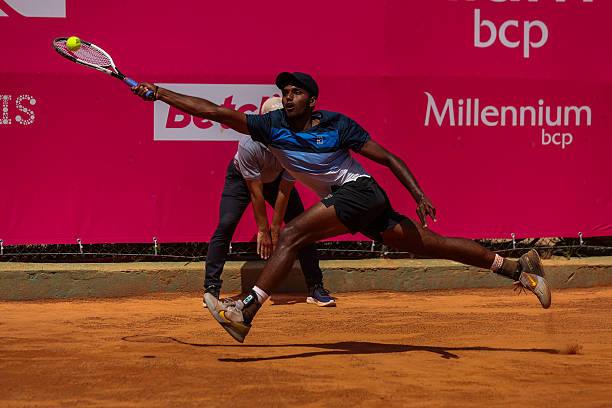
Manas Dhamne - Photo by Carlos Rodrigues/Getty Images
Sahaja Yamalapalli was in the Netherlands when the news reached her, in the middle of the ITF circuit's late summer swing, the part of a professional season that produces no headlines and pays for itself only if you keep winning. On 22 August the Ministry of Youth Affairs and Sports cleared 492 athletes across 35 disciplines for the Asian Games at Aichi-Nagoya. Tennis received seven places. The All India Tennis Association had asked for twelve. Yamalapalli, ranked 344 in the world and the highest ranked Indian woman in singles, was not among the seven. "I am really shocked and disappointed to hear this," she told PTI. "I was very much looking forward to competing in the Asian Games."
Four others were cut with her: Vaishnavi Adkar at 390, Vaidehee Chaudhari at 437, the doubles veteran Prarthana Thombare and the teenaged Manas Dhamne, the only man cut. What remained was five men and two women. Ankita Raina and Rutuja Bhosale carry the women's draw between them.
Begin with the arithmetic, because the arithmetic is unusually legible. India entered nine tennis players at Guangzhou in 2010. Twelve were named for Incheon in 2014 and twelve travelled to Jakarta and Palembang in 2018, six men and six women each time. Nine went to Hangzhou in 2023. Across sixteen years the contingent has held within a narrow band, nine at the low end and twelve at the high, irrespective of which party held office or which faction held the federation. Seven is the smallest Indian lawn tennis contingent at an Asian Games since at least Guangzhou, and it arrives not from injury or withdrawal but from an administrative decision taken ten weeks after the federation published its list.
The rule that produced it is public and predates the controversy. On 24 September 2025 the ministry notified selection criteria for the Asian Games and other multi-sport events. An athlete in an individual event becomes eligible on any of three counts: she has matched or bettered the sixth place performance from the previous Asian Games; she has finished sixth or better at the last Senior Asian Championships; or she sits within the top six of Asian nations in the international rankings. Teams need a top eight standing. The document is candid about its purpose. The ministry, it states, "may not approve the names recommended by National Sports Federations, if the aim is just for participation and not aiming for excellence." A relaxation clause permits exceptions on the advice of the Sports Authority of India or sport-specific experts. In tennis it was not exercised.
Mansukh Mandaviya has been consistent about the reasoning. Capping the contingent at 600 in early July, the minister said that "Asian Games is not an exposure tour, it is a platform for athletes to make the country proud with their best performance," and, more bluntly, that "only those who can deliver will travel." The position deserves a fair hearing rather than a caricature. Indian delegations to continental Games have historically carried passengers, and participation certificates have long functioned as currency in the reserved government jobs that sustain many athletic careers. Football, ranked in the twenties in Asia, has been kept home under the same rule. Tennis has not been singled out.
Yet the mechanism is not quite the mechanism the new law describes. The National Sports Governance Act came into force in 2025, with the National Sports Bodies Rules notified in January 2026 and the Board and Tribunal Rules in May. Its preamble affirms that the Government of India "respects the principle of autonomy of the sports governing bodies in the country." Section 27(3) provides that no person shall represent India in a designated sport "without an authorisation by a National Sports Body or its affiliate unit," which locates the power to send a player with AITA rather than with the ministry. Section 35(2) does allow the Central Government to restrict participation, but only "under extraordinary circumstances and in the interest of national security, public order and safety." A judgement about medal probability at a continental Games does not obviously belong in that category.
The government's real lever sits elsewhere, in Section 14: only a recognised sports organisation may receive grants or financial assistance from the Centre. What the ministry exercised on 22 August was the power of the purse, not a statutory power of selection. AITA remains free in principle to authorise whomever it likes. It is not free to pay for them. Much of the commentary has flattened that distinction into a simpler story of the state overriding the federation.
The Act also closes the door a dispute of this kind would ordinarily walk through. Section 20(a) bars the newly constituted National Sports Tribunal, the law's flagship instrument for resolving sporting grievances, from adjudicating any dispute "arising during the Olympic Games, Paralympic Games, Commonwealth Games, Asian Games, or any other similar events." What remains is Section 13(3), the internal grievance mechanism every national body must maintain. The five would be appealing to the federation that selected them, against a ministry not party to the process, three weeks before the Games open.
AITA's own position is delicate. Announcing the twelve on 15 June, secretary general Sunder Iyer said the selection committee, chaired by Nandan Bal, "has carefully evaluated performances across the professional circuit and selected a team that combines experience, current form and future potential." The federation has not publicly contested the ministry's revision. It is in no condition to. In June the Delhi High Court, hearing a petition by the former players Somdev Devvarman and Purav Raja, ordered AITA to rewrite a constitution unchanged since 2000 and to hold fresh elections by 30 September, with an administrator supervising the interim. The body in which Section 27(3) vests the authority to send Indians to Nagoya is being reassembled while the Games approach.
Around this sit the constituencies with no formal standing. Parents and small sponsors finance the middle years of an Indian tennis career, the stretch between junior promise and the top 200 when there is no federation salary and no endorsement. Adkar came up through the ITF circuit out of Pune; Yamalapalli through Hyderabad and a scholarship at Sam Houston State. Their backers wrote cheques against a ranking system, and a threshold applied after the fact has now overruled it. The table tennis player Manika Batra, dropped under a quite different formula devised by her own federation, has raised the same complaint about thresholds that shift between cycles.
There is one more thing the seven names reveal. The cut fell almost entirely on the women. AITA had nominated Yamalapalli, Adkar and Chaudhari for women's singles and Bhosale, Raina and Thombare for the doubles. The ministry removed every one of the singles nominees and one of the three doubles players, leaving two women against five men. On the men's side it removed a single teenager and kept the rest, including the doubles specialists Yuki Bhambri, who has climbed inside the world's top 25, Sriram Balaji and Anirudh Chandrasekar. Read against the top six in Asia threshold this is coherent. Read as a portrait of Indian tennis it is a statement that the women's game currently has no singles player the state is willing to fund.
India's last Asian Games tennis gold came in Hangzhou, from Rutuja Bhosale and a 43-year-old Rohan Bopanna in mixed doubles. No continental ranking predicted it. That proves nothing about the five who will not travel. It is simply the kind of fact a threshold cannot hold, and the kind that will be argued over in Nagoya whichever way the draw falls.

Keep Reading

The Capacity for Suffering
On the baseline, greatness is written in sweat and split seconds: endure the long rally, find the line under pressure, adapt at match point, and take the next…
US Open: No Sinner, No Certainty in an Open Draw
Jannik Sinner is out, Alexander Zverev is top seed and Carlos Alcaraz returns after four months. Inside the 2026 US Open draw at Flushing Meadows.
US Open: The Crucible at Flushing Meadows
Discover how tennis stars battle grueling injuries and physical strain at the US Open, competing under the electric lights of Flushing Meadows in Queens, NY.