South Africa Crumble to Expose Modern Cricket's Concentration Crisis

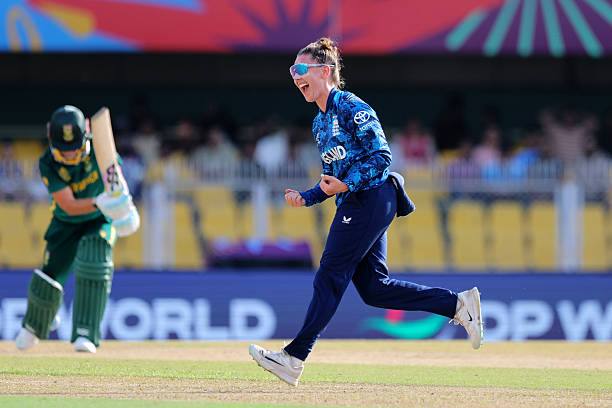
England's clinical dismantling of South Africa—bowling them out for 69 in just 20.4 overs before chasing down the target in 14.1 overs without loss—represents more than just a dominant World Cup performance. It exposes a deeper malaise afflicting modern cricket: teams' systematic inability to apply themselves over sustained periods, a phenomenon that transcends formats and skill levels.
South Africa's capitulation at the Barsapara Stadium follows a disturbingly familiar pattern in contemporary cricket. After electing to bat first, the Proteas lost four wickets for just 19 runs within six overs, with only Sinalo Jafta (22) reaching double figures in their eventual total of 69—their second-lowest World Cup score.
Unplayable bowling conditions didn't precipitate the collapse. England's spinner Linsey Smith returned remarkable figures of 3/7 from four overs, dismissing captain Laura Wolvaardt, Tazmin Brits, and Marizanne Kapp with deliveries that, while skillful, required better application from experienced international batters. The pitch offered minimal assistance to bowlers, yet South Africa's batters appeared to capitulate under the pressure of their own burdened minds.
Modern cricket's concentration crisis stems from multiple psychological factors. There is evidence to suggest that mental fatigue significantly impairs athletic performance. Research has shown that mental fatigue can negatively impact both physical abilities and decision-making capabilities in professional players.
The sustained cognitive load required for modern cricket—particularly in high-pressure situations—creates what researchers term "cognitive fatigue". This manifests in deteriorating visual attention and executive functioning as innings progress, directly correlating with the type of batting collapses witnessed across formats. England's bowlers, led by Smith's intelligent variations and captain Nat Sciver-Brunt's tactical acumen (2/5 from her overs), systematically exploited these cognitive vulnerabilities.
Research on performance slumps in elite cricket identifies anxiety and insecurity as primary maintenance factors in team collapses. As pressure mounts, players experience a fear of making mistakes, leading to excessively cautious or, at times, poor judgment of risks, which compounds the situation with errors. South Africa's batting exemplified this psychological spiral—tentative strokes, defensive mindsets, and increasingly desperate shot selection as wickets tumbled.
Contemporary cricket places unprecedented cognitive demands on players. The proliferation of data analytics, social media scrutiny, and high-stakes tournaments creates a cauldron of pressure. Unlike previous generations who faced relatively straightforward tactical scenarios, modern players must process multiple variables simultaneously while maintaining technical precision under intense observation.
A 2019 study by Brown, Butt, and Sarkar emphasizes the shifting demands of modern-day cricket. The perceived importance of games significantly increases competitive anxiety, particularly relevant in World Cup contexts where careers and national pride intersect. South Africa's early collapse suggests an inability to manage these layered pressures—a failing that extends beyond individual technical deficiencies to reflect broader systemic issues in mental preparation.
Studies of resilience in elite cricket reveal that controlling performance states through awareness and mastery of psychological processes represents a crucial skill. Research participants who successfully navigated performance slumps demonstrated the ability to control cognitive processes, maintain focus, and regulate arousal—precisely the capacities that appear to be diminishing in modern cricket.
The psychological literature identifies challenge versus threat appraisal as fundamental to sustained performance. Players who view pressure situations as opportunities rather than threats maintain better concentration and decision-making capabilities. England's bowlers demonstrated this mindset through their patient, systematic approach, while South Africa's batters appeared overwhelmed by the magnitude of the occasion.
England's comprehensive victory—their third 10-wicket ODI result in World Cup history—highlights not just their own excellence but cricket's broader concentration crisis. The ease with which established international players surrender once pressure mounts suggests fundamental gaps in mental skills training across the sport.
The Guwahati match serves as a microcosm of cricket's evolving challenge: in an era where technical skills have never been higher, the mental capacity to apply those skills consistently over extended periods appears increasingly fragile. Until cricket addresses this psychological dimension with the same rigor applied to physical conditioning and technical coaching, such collapses will remain disturbingly commonplace features of the international game.
Linsey Smith celebrates the dismissal of Marizanne Kapp - Photo by Pankaj Nangia/Getty Images

Keep Reading

The Capacity for Suffering
On the baseline, greatness is written in sweat and split seconds: endure the long rally, find the line under pressure, adapt at match point, and take the next…

US Open: No Sinner, No Certainty in an Open Draw
Jannik Sinner is out, Alexander Zverev is top seed and Carlos Alcaraz returns after four months. Inside the 2026 US Open draw at Flushing Meadows.

US Open: The Crucible at Flushing Meadows
Discover how tennis stars battle grueling injuries and physical strain at the US Open, competing under the electric lights of Flushing Meadows in Queens, NY.