Maria Jose Marin shows steely resolve to clinch ANWA Championship

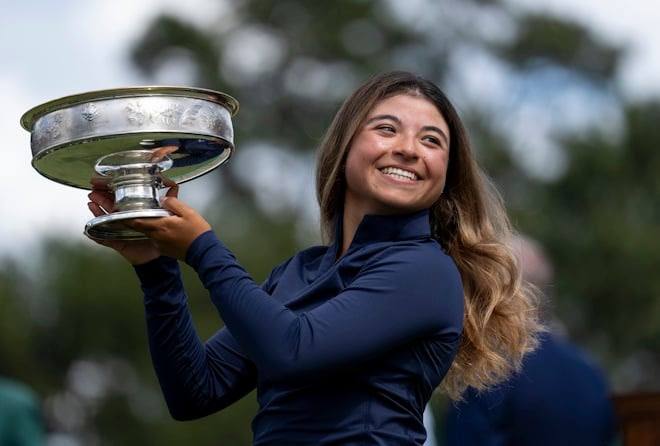
The Augusta National Women’s Amateur did what it so often does at the end of its week long two-course audition. It didn’t simply reward the cleanest swing or the hottest putter. It crowned the player who handled the moment best when the air got heavy and the margins got cruel.
That player was Maria José Marín.
Marín closed with a final-round 68 at Augusta National to reach a record 14-under and win the 2026 ANWA, becoming the first South American champion in the event’s history.
The turning point: when the final group blinked
The final group had a different script in mind. Asterisk Talley, the teenage American whose name has become shorthand for early greatness, and Meja Örtengren, Sweden’s calm, powerful Stanford sophomore, started the day with the cleanest path to the trophy.
But Augusta isn’t a place where you hang around. It’s a place that asks you to decide—and then live with the decision.
Talley’s slide was sudden and decisive. On the par-3 12th, Golden Bell, she found the tournament’s most famous trapdoor, and her chances went with it. The beast at the haunted twelfth woke up and devoured Talley, because the hole didn’t just cost strokes; it flipped the tournament’s emotional balance. She made a seven after sending her ball into the water from the greenside bunker, twice over.
Örtengren, grouped with Talley, also drifted backward as the back nine demanded precision and nerve. The same pairing that began the day controlling the narrative finished reacting to it, watching Marín move from chaser to closer.
Marín didn’t need chaos. She simply didn’t panic when it arrived.
Marín’s emergence here is not an overnight phenomenon, but it still feels like a surge. She is Colombian, and her rise has mattered back home because it expands the map of what’s normal in elite amateur golf. She arrived at ANWA already carrying real form—she was near the top of the leaderboard after a 69 in the second round at Champions Retreat, sitting second as the event shifted toward Augusta National.
What makes her story stick isn’t just geography. It’s how quickly she has learned to belong in spaces that used to feel far away.
That’s where Arkansas comes in.
The Razorback factor: pressure as a training environment
Being a Razorback has become one of the most direct pipelines to high-level women’s golf, and Marín has taken full advantage. Arkansas has high hopes for the Colombian, placing her in the program’s tight inner circle alongside names like Stacy Lewis and Maria Fassi. That kind of collegiate environment changes you: week after week against elite fields, expectations aren’t theoretical—they’re posted on scoreboards.
Even the way people inside the sport talk about Marín carries a distinct tone. NBC Sports framed her NCAA title run with a simple idea: she doesn’t just play well when things are comfortable; she plays well when they’re tense.
That’s a pretty good summary of what it takes to win at Augusta.
On Saturday, while the final group stumbled, Marín looked like someone who’d already rehearsed this exact feeling—heart rate up, decisions magnified, no free shots. She kept choosing clarity over adrenaline, and the tournament kept opening.
By the time the last putts fell, ANWA had its newest champion—and Colombia, Arkansas, and the women’s amateur game all had a new reference point for what the next wave can look like.

Keep Reading

The Capacity for Suffering
On the baseline, greatness is written in sweat and split seconds: endure the long rally, find the line under pressure, adapt at match point, and take the next…
US Open: No Sinner, No Certainty in an Open Draw
Jannik Sinner is out, Alexander Zverev is top seed and Carlos Alcaraz returns after four months. Inside the 2026 US Open draw at Flushing Meadows.

US Open: The Crucible at Flushing Meadows
Discover how tennis stars battle grueling injuries and physical strain at the US Open, competing under the electric lights of Flushing Meadows in Queens, NY.