Kuldeep Yadav spins India into control against a battling West Indies

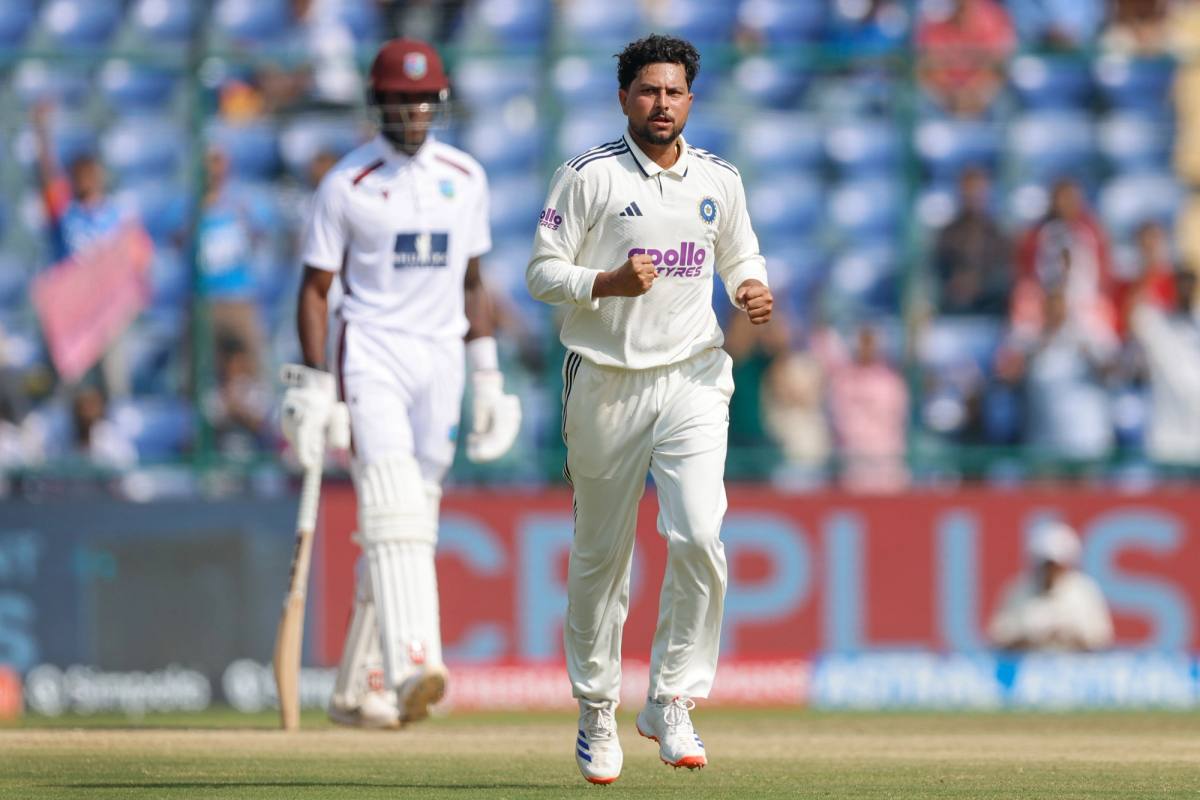
Batting beneath a haze of Delhi heat and under the steady scrutiny of a partisan crowd, the West Indies have found a strand of stubbornness in this second Test against India. At stumps on day three, the visitors were 173 for 2 in their follow-on innings, led by a vital, unbeaten partnership between John Campbell (87*) and Shai Hope (66*). They still trail by 97, but despite conceding eight wickets on the day, the Windies have finally shown some fight.
Brian Lara and Viv Richards may finally enjoy their drink and a satisfying dinner. Incredibly, for the first time this year, the Windies managed to force the second new ball. The 138 runs that Campbell and Hope added through some patient batting gives them the hope of respect. Incidentally, for the first time this series, both men have also surpassed a century of deliveries in their stoic vigil at the Kotla. Campbell remains standing, past his best Test score, and Hope found respite from a half-century after waiting for 31 innings without one. It’s the sort of determined stand, slow-burning but steeped in resilience, that West Indies fans have been craving.
The match was setup on a first-innings declaration at 518 for 5—built on a silken 175 from Yashasvi Jaiswal, 129* from Shubman Gill, and a powerful 87 from Sai Sudharsan—placing the hosts firmly in command. But it was the spin of Kuldeep Yadav that pried the West Indies’ first innings apart. On a surface with little bite, Kuldeep wove flight, drift, and subtle turn into a quietly devastating haul of 5 for 82—his fifth Test five-for. He was probing the bat constantly, surveying the channel to the wickets, rarely ever drifting too wide. It was a remarkable show of discipline, from a quality left arm spinner playing just his 15th test over nearly a decade of life at the top echelons of Indian cricket.
The West Indies, who showed brief middle-order pluck through Khary Pierre and Anderson Phillip (a dogged 16.5 over stand), wilted to 248 all out. Follow-on was enforced. Yet the game, as the day's final hours would prove, was far from over.
Their bowlers, notably Bumrah and Siraj, operated with intensity but also the need for restraint, perhaps explaining why Bumrah was called upon only after 32 overs in the second dig. Bowling on an unyielding pitch, India’s attack traded aggression for conservation, as they dropped a gear, perhaps from the exertions of bowling more than 80 overs in the first innings. After an early breakthrough from Siraj (removing Chanderpaul on the pull) and Washington Sundar’s peach to bowl Athanaze, the hosts let it drift. Campbell and Hope mixed sound defence with bursts of aggression—Campbell sweeping Kuldeep for six and taking advantage of loose lines, Hope countering with deft touch and a couple of imperious boundaries.
But when they resume on Sunday, India might march out on Fresher legs and finally find some bite from the Kotla strip. It will take a monumental effort from Hope and Campbell to continue their heroics long enough to deny India anything less than another massive victory.

Keep Reading

The Capacity for Suffering
On the baseline, greatness is written in sweat and split seconds: endure the long rally, find the line under pressure, adapt at match point, and take the next…

US Open: No Sinner, No Certainty in an Open Draw
Jannik Sinner is out, Alexander Zverev is top seed and Carlos Alcaraz returns after four months. Inside the 2026 US Open draw at Flushing Meadows.
US Open: The Crucible at Flushing Meadows
Discover how tennis stars battle grueling injuries and physical strain at the US Open, competing under the electric lights of Flushing Meadows in Queens, NY.