Cameron Young surges into a share for the lead with scrambling Rory McIlroy

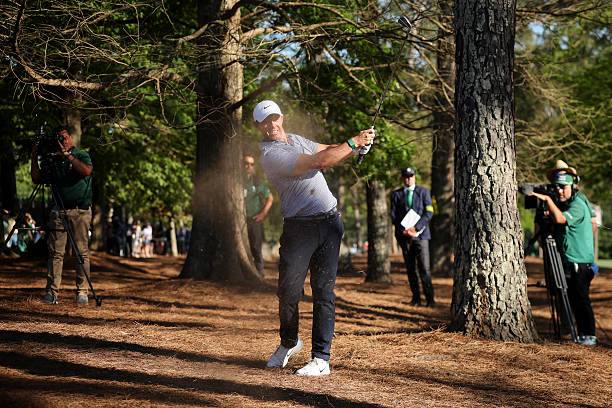
Cameron Young’s name did not so much appear on the leaderboard as slowly materialize, like something you only notice once it has already changed the room. Through two days he had been the quiet geometry in Rory McIlroy’s rear-view mirror: long, accurate, steadily mapping Augusta’s contours with 326‑yard drives and 40 greens in regulation out of 54, the profile of someone playing the course more than playing the field. Saturday’s 65 was not a bolt from nowhere; it was the moment the underlying pattern finally became visible.
Young’s emergence into a share of the lead came from a commitment to restraint rather than theatrics. Across three rounds he has missed only five fairways, leading the field in accuracy off the tee while still ranking near the top in distance. That particular combination – high carry, low dispersion – changes the decision-making landscape at Augusta: par‑5s become second-shot puzzles, not recovery exercises, and long par‑4s become wedge holes instead of tests of tolerance. It is no surprise that with 40 greens hit and just 83 putts – well under 1.6 per hole – Young sits tied for the tournament lead despite never once needing to hole a three‑putt apology.
What gave the round its texture was not the fireworks but his tolerance for boredom. Young openly described the discipline of aiming 20 or 25 feet away from trouble all day, trusting that a few would land closer and a few putts would fall. Sixteen greens in regulation in Round 3, at a course where the field is averaging north of 73, is what happens when a player leans into that bargain. Even his luck – the carom off patrons on 9, the reprieve from the trees on 13 – did not prompt him to rip the script up. He took the good breaks, absorbed the bad ones, and went back to the same, almost ascetic, target lines.
There is a kind of counter‑narrative power in that. Young came here having just won THE PLAYERS, carrying the knowledge that he could close on a Sunday with the entire infrastructure of the sport watching. His description of that day – stay in his lane, accept that everyone will make both runs and bogeys, look up only with a couple of holes to go – reads less like sports cliché than like a method for living inside modern major-championship pressure. It is no accident that he talks more about routine than destiny, more about mass times with his children than about legacy; for a player who once collected close calls at majors like scar tissue, this is an identity rebuild as much as a leaderboard move.
While Young was playing a kind of minimalist chess, McIlroy was experiencing the more familiar volatility of defending champion with a six‑shot cushion. He did not collapse in any melodramatic sense – his 73 leaves him still tied for the lead – but the texture of his round carries the shape of a player caught between aggression and self‑preservation. The statistical outline is revealing: McIlroy has hit only 36 greens in regulation, four fewer than Young, yet required just 81 putts, the best total in the field. When your putter is propping up your ball‑striking at Augusta, the margins become thin enough that a single swing can feel like a narrative turn.
That swing came at 11. McIlroy walked off the 10th green with the sense that he had “turned the round around” after a birdie, only to watch a well‑struck, drawing second shot drift on the wind and trickle into the water. In isolation, it is an understandable error on the course’s hardest hole, but psychologically it did more work: he admitted to feeling “a little bit uneasy on 12 and 13” in its wake, guarding against the miss that had just hurt him. On a day when the course was “gettable” and the chasing pack was going low, that subtle tightening – the club held a fraction longer, the swing shortened on an “awkward yardage” wedge at 12 – was enough to turn a defensive nine into a narrative of slippage.Rory-McIlroy.
You can see the contradiction in his own language. McIlroy speaks of the need to “stay aggressive, stay committed, taking shots on even if you are uncomfortable with them,” and of playing as if he “already has a green jacket, which I do.” Yet in the next breath he catalogues the left misses on 6 and 12, the awkward lies with the ball above his feet, the sense that his body stalled just enough for the ball to turn over. The statistics back the feeling: only 21 fairways hit in 42 tries and just two‑thirds of greens found forces him to lean heavily on those 1.5 putts per hole and a strong bunker record to preserve par. It is golf as damage limitation rather than expansion.
The deeper story of Saturday, then, is not simply that McIlroy’s six‑shot lead disappeared and Young’s name rose to meet his. It is that two different theories of control met in the same final pairing. Young’s approach treats Augusta as a system to be managed: wide tee shots that still find grass, conservative targets on firm greens, a willingness to let birdies “back their way in” over time. McIlroy’s day suggested a more fragile equilibrium, where elite putting and scrambling can offset imperfection tee‑to‑green, but where one misjudged gust at 11 can reverberate down Amen Corner and turn aggression into something that merely feels like it.
On Sunday, they will go out again together, the defending champion who insists he already owns the jacket and the new contender who keeps saying he is “owed nothing” by his recent surge. One has been forced to confront what it means to keep putting himself “out there” when the swing does not quite match the stakes; the other has spent a year learning how to stay present enough that the stakes never quite colonize the swing. Between them lies 18 holes and a question Augusta loves to pose: are you ready for the most demanding test of character and composure?
Rory McIlroy - Photo by Hector Vivas/Getty Images

Keep Reading

The Capacity for Suffering
On the baseline, greatness is written in sweat and split seconds: endure the long rally, find the line under pressure, adapt at match point, and take the next…
US Open: No Sinner, No Certainty in an Open Draw
Jannik Sinner is out, Alexander Zverev is top seed and Carlos Alcaraz returns after four months. Inside the 2026 US Open draw at Flushing Meadows.
US Open: The Crucible at Flushing Meadows
Discover how tennis stars battle grueling injuries and physical strain at the US Open, competing under the electric lights of Flushing Meadows in Queens, NY.