Badminton takes a racy fifteen point turn

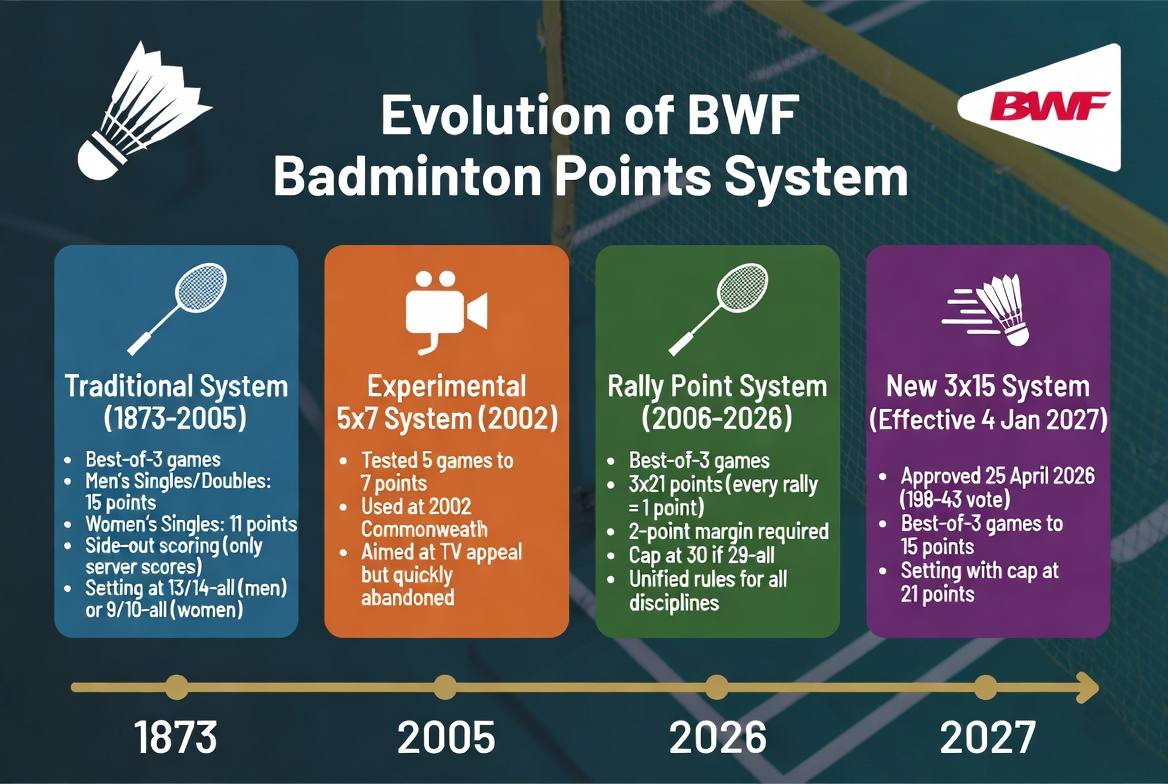
At the 87th BWF Annual General Meeting, members approved the switch from the 3x21 scoring system to 3x15 by the required two-thirds majority. Effective 4 January 2027, each game will now be won by the first to 15 points (with a two-point lead required; the “setting to 21” clause from testing allows extension in deuce for fairness). BWF President Khunying Patama Leeswadtrakul hailed it as “an important milestone,” promising tighter scores, dramatic finishes, improved scheduling, and better player welfare. The change, tested extensively against 5x11 and the status quo, emerged as the best balance of excitement, fairness, and practicality. But does it strengthen badminton’s soul or trade its essence for convenience?
From first principles, badminton is a game of explosive rallies, geometric precision, rapid decision-making, and layered tactics played on a 13.4-metre court where every centimetre and millisecond matters. The shuttle’s 300 km/h speeds demand anaerobic power, footwork agility, and mental composure. Scoring systems are not neutral; they are force multipliers that reshape incentives. The 21-point era (introduced in 2006 to replace outdated side-out 15-point rules) rewarded sustained pressure, comebacks, and endurance. A player down 8-14 still had 13 points of runway to engineer a turnaround. Matches could stretch 80-90 minutes, testing aerobic capacity and tactical patience.
The 3x15 format compresses that runway by roughly 30%. Each point now carries proportionally greater weight. High-pressure moments arrive earlier—often by the 8-8 mark—and the margin for error shrinks. Data from BWF trials showed more “close scenarios,” higher frequencies of critical points, and more predictable match durations. Fans get sustained intensity rather than mid-game lulls; broadcasters get reliable windows; tournament organisers gain operational certainty. For players, reduced cumulative court time promises lower overload injuries, faster recovery, and longer careers—an explicit goal in an era of packed calendars and ageing stars like PV Sindhu and Kidambi Srikanth.
Critically, however, compression alters the sport’s character. In a 21-point game, elite players could absorb early deficits, probe weaknesses, and impose long rallies that exposed fitness gaps. The new format narrows the strategic window. Slow starters are punished brutally; a 4-0 hole at 15 is existential. Momentum swings become sharper but less recoverable. Chinese star Shi Yuqi, who experienced 15-point play in domestic leagues, called it “much harder to manage tactically” and an advantage for “younger and more agile players” who deliver explosive energy bursts. Olympic champion Chen Yufei welcomed the faster pace and unpredictability, while Athletes’ Commission chair PV Sindhu voiced the mixed player sentiment: innovation is needed, yet many value the 21-point “charm, rhythm and tactical depth.”
This shift risks favouring a narrower archetype: the explosive aggressor over the grinder. Doubles specialists like Satwiksairaj Rankireddy may thrive on the fast-paced exchanges, but singles could see fewer marathon rallies that once showcased defensive mastery and endurance. Comeback narratives—central to badminton’s drama—may diminish. At recreational levels, the forgiveness that lets club players learn through long rallies could evaporate, potentially discouraging newcomers. There is also the injury paradox: while total fatigue drops, per-rally intensity may rise, shifting risk from chronic overload to acute strain. BWF’s own medical panel chair, Dr Niels Christian Kaldau, noted the unknowns: shorter days aid recovery, but training adaptations remain untested.
Yet the change is not revolutionary—it is evolutionary. Badminton has survived scoring tweaks before. The 2006 rally-point reform itself was once controversial. The sport’s DNA—skill, tactics, physical and mental demands—remains intact, as Leeswadtrakul emphasised. Shorter, snappier matches could broaden appeal in a TikTok-scrolling world without sacrificing elite drama. Consistent durations ease the punishing schedule that currently shortens careers. If implemented thoughtfully, the format could sustain legends longer while injecting fresh unpredictability that keeps casual viewers hooked.
Adapting to 3x15: Techniques and Skills That Will Define Success
Players cannot simply “play faster.” Adaptation requires deliberate reprogramming across physical, technical, tactical, and mental domains.
Physical priority: Train anaerobic power and explosive footwork. Current endurance blocks must pivot toward repeated high-intensity intervals—short, all-out rallies with minimal rest—mirroring the compressed game length. Recovery between games becomes premium; plyometrics, agility ladders, and shuttle-specific speed drills will matter more than long steady-state cardio.
Technical edge: Serve and return quality becomes decisive. In 21-point play, a shaky start could be overcome; at 15, early points are gold. Elite servers will weaponise disguise and placement to steal cheap points. Receivers must neutralise immediately. Drills should isolate the first three-shot sequences under pressure.
Tactical recalibration: Aggression from rally one. Players must dictate tempo early rather than settling in. Pre-match video analysis gains urgency—opponent tendencies must be exploited in the first five points. Mid-game adjustments shrink; coaches will emphasise “win the start, manage the finish.” Risk-reward calculations tilt toward proactive attack and deception to force errors before opponents stabilise.
Mental steel: The psychological load intensifies. Every point feels like a match point. Techniques include pre-game visualisation of high-stakes scenarios, breathing resets between points, and reframing deficits as opportunities rather than disasters. Mental toughness training—pressure simulations in practice—will separate champions from the rest.
The skills that will matter most: (1) explosive court coverage and shot power for instant point-winning; (2) anticipation and decision velocity under time pressure; (3) shot variety and deception to create chaos in shorter windows; (4) adaptability to read opponents faster; and (5) unflinching composure when scores tighten early. Younger athletes with raw athleticism may enjoy an initial edge, but disciplined veterans who master these adjustments could extend dominance precisely because the format rewards precision over attrition.
The 3x15 era is not a dilution of badminton; it is a stress test of its adaptability. BWF promises ongoing consultation. If the transition supports players through targeted coaching pathways and preserves the sport’s tactical richness, the change could deliver a more sustainable, spectator-friendly future. If it homogenises styles or erodes depth, nostalgia for the 21-point grind will grow. Either way, the first rallies of 2027 will reveal whether badminton has found the right tempo for the next generation—or simply traded one beautiful struggle for another. The shuttle is in play. The sport’s response will define its next chapter.

Keep Reading

The Capacity for Suffering
On the baseline, greatness is written in sweat and split seconds: endure the long rally, find the line under pressure, adapt at match point, and take the next…

US Open: No Sinner, No Certainty in an Open Draw
Jannik Sinner is out, Alexander Zverev is top seed and Carlos Alcaraz returns after four months. Inside the 2026 US Open draw at Flushing Meadows.

US Open: The Crucible at Flushing Meadows
Discover how tennis stars battle grueling injuries and physical strain at the US Open, competing under the electric lights of Flushing Meadows in Queens, NY.