Alcaraz, Sabalenka and the Next Wave assert themselves in Melbourne

The first week of this Australian Open has felt less like the orderly beginning of a Grand Slam and more like a stress test of tennis’s new world order: the era in which Carlos Alcaraz and Jannik Sinner are supposed to take over, Aryna Sabalenka and Coco Gauff are supposed to hold the line, and Novak Djokovic is supposed to bend time a little longer. Through the first week in Melbourne, that script is mostly intact, but it has already been smudged by heat, nerves, qualifiers with nothing to lose, and the quiet weight of careers trying to restart or not to end.
New order, same pressure
The draw promised a tournament about rivalries and records: Alcaraz chasing a career Slam at just 22, Sinner defending his title, Djokovic looking to add yet another Australian chapter, and Sabalenka and Swiatek circling each other on the women’s side. Through the first week, the leaders have held, but rarely without reminders that authority is always provisional in Melbourne’s heat. Alcaraz has advanced while fiddling with a “new-look” serve that already has commentators flirting with Djokovic comparisons, surviving a 78‑minute opening set on Day 4 that suggested both vulnerability and depth.
Sabalenka, opening her campaign for a third title in four years, has moved efficiently into the second week, her early rounds again looking like a private training block held in public. Gauff has been slightly less crisp, pushed hard by fellow American Hailey Baptiste, but she, too, is still there, her Roland Garros title and top‑tier status now part of a new normal rather than an exception. Djokovic and Sinner have progressed with fewer theatrics, their early rounds reminders that experience and habits still travel well, even when the locker room is getting younger around them.
The upsets that give a major its shape
If the favourites have done enough, it is the undercard that has given the tournament its texture: the qualifiers, teenagers, and home wildcards whose names are written in the draw in a smaller font but who play like no one told them. British qualifier Arthur Fery produced the tournament’s first shock by taking out No. 20 seed Flavio Cobolli in four sets on the opening day, turning a sun‑drenched outside court into his own laboratory of risk and resilience. Australian wildcard Talia Gibson followed with a brisk 6‑1, 6‑3 dismissal of world No. 40 Linda Noskova, a win that both delighted the home crowd and underlined how porous the supposed border between “top‑40” and “local hope” can be in the first week of a Slam.
Day 5 added its own jolt when 19‑year‑old Nikola Bartunkova stunned Olympic champion Belinda Bencic in three sets, a match that swung from 6‑3 control to a 0‑6 collapse and back to 6‑4 nerve. That oscillation—a teenager absorbing a mid‑match implosion and still finishing—is exactly the kind of psychological hinge that often predicts who will be back in the second week of majors, even if not this one. In doubles, local heroes Nick Kyrgios and Thanasi Kokkinakis also exited early, losing to fellow Australians Jason Kubler and Marc Polmans, a result that turned Rod Laver Arena into a study in conflicted patriotism: the roar for the upset, the hush for what it might mean for the more famous pair.
The quiet grind of the favourites
For all the noise around the shocks, the shape of the tournament still tilts toward the names on the billboards. Alcaraz’s march through the draw has mixed showmanship with an almost bureaucratic efficiency: he has already been dragged into long sets and flashy exchanges, particularly in his third‑round win over Corentin Moutet, yet has tended to close the door abruptly once the momentum is his. That capacity—to entertain, then to suffocate—remains the clearest sign that his push for a career Slam here is less marketing line than plausible trajectory.
Sabalenka’s early‑round ruthlessness has become its own storyline. She has not dropped the sort of sloppy set that used to lurk in her majors, and she continues to talk about “disconnection” and reconnecting with her game in ways that suggest she understands how fragile dominance can be. Gauff’s path has been trickier, but her capacity to recalibrate within matches—tightening on serve, flattening out the forehand when it counts—has again been the difference between a precarious first week and a productive one. On the men’s side, Sinner and Djokovic are advancing with an economy that almost downplays the stakes; their first week has been about conserving rather than announcing, banking energy for the closing weekend that everyone quietly assumes they will reach.
Disappointments, large and small
For others, the first week has been about confronting ceilings they thought they had already broken. Emma Raducanu’s second‑round defeat extended a string of early exits at majors, and her own post‑match assessment—admitting that her initial rise was “too sudden”—landed less as excuse than as a sociological diagnosis of modern tennis stardom. In a sport that now churns teenage champions into global brands almost overnight, Raducanu’s struggle to reconstruct a sustainable career from that spike has become one of the tour’s more sobering ongoing narratives.
At home, Maya Joint’s first‑round loss to Tereza Valentova offered a different version of disappointment. Joint came into the tournament as Australia’s top‑ranked woman and a key piece of Tennis Australia’s future planning, but left talking about using the defeat as a “learning moment” and resolving to come back stronger next year. Local doubles favorites Kyrgios and Kokkinakis, exiting early again, have added to a broader sense that Australia’s tennis identity is in flux: a country used to building its narrative around flamboyant men’s singles stars now finds itself looking more to a diversified field of singles and doubles players, men and women, without a single central figure.
A tournament in transition
Viewed from a distance, the first week in Melbourne has been less about shock cataclysms than about incremental re‑ordering: the consolidation of a new elite, the emergence of another wave underneath, and the slow recalibration of expectations for those caught in between. The second week will tell whether this Australian Open becomes another step in Alcaraz and Sinner’s joint project to define men’s tennis, whether Sabalenka can continue to turn early‑round dominance into trophies, and whether Gauff and Swiatek end up sharing the hard‑court space they now co‑own in theory.
For now, the essence of the tournament lies in its contradictions: packed night sessions that still feel slightly experimental, legends who keep winning while the future accelerates around them, and a set of young players whose most important work this fortnight may be the matches they lost. On paper, the favourites are where they were supposed to be at the end of week one; on the ground, under the lights and in the outer courts’ heat, Melbourne already feels like a place where the hierarchy is being renegotiated in real time.
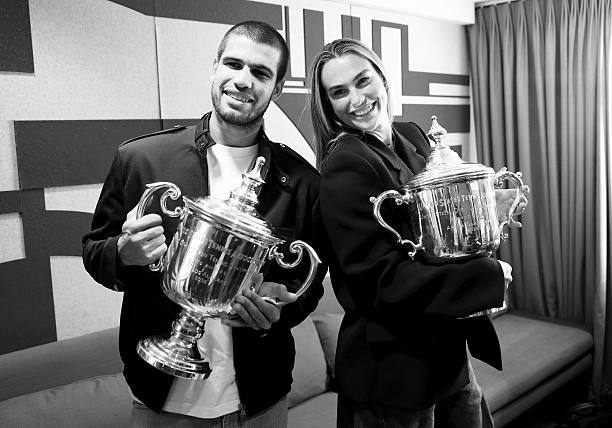
Carlos Alcaraz and Aryna Sabalenka - Photo by Clive Brunskill/Getty Images

Keep Reading

The Capacity for Suffering
On the baseline, greatness is written in sweat and split seconds: endure the long rally, find the line under pressure, adapt at match point, and take the next…
US Open: No Sinner, No Certainty in an Open Draw
Jannik Sinner is out, Alexander Zverev is top seed and Carlos Alcaraz returns after four months. Inside the 2026 US Open draw at Flushing Meadows.
US Open: The Crucible at Flushing Meadows
Discover how tennis stars battle grueling injuries and physical strain at the US Open, competing under the electric lights of Flushing Meadows in Queens, NY.